

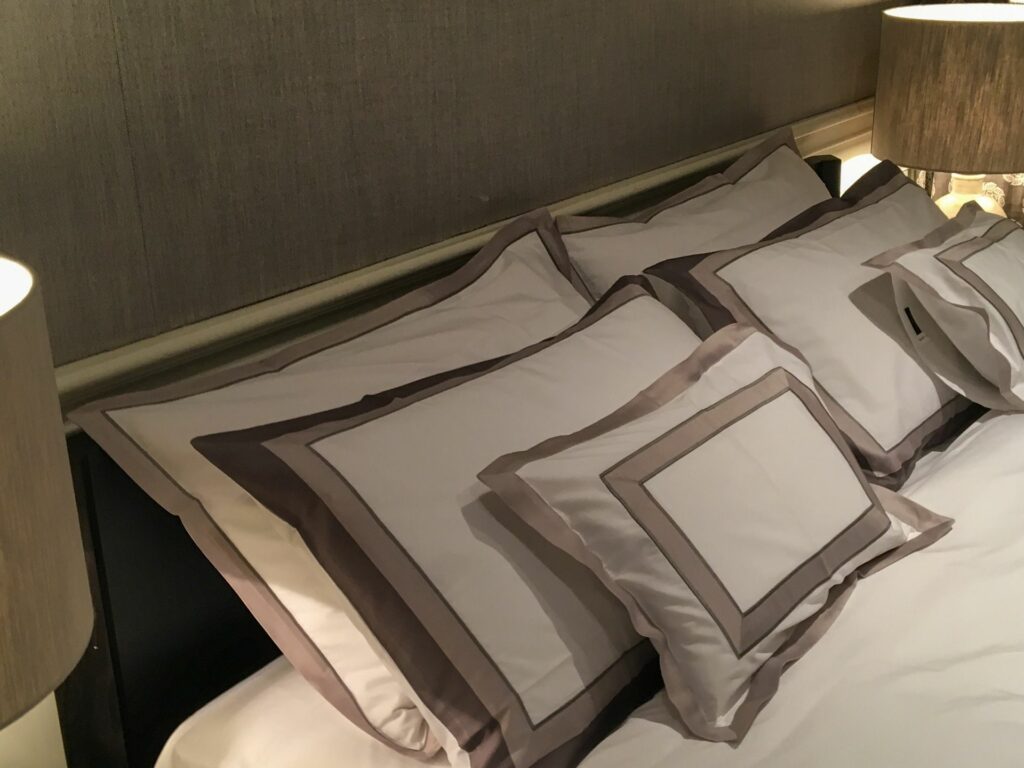
Harmony is not about making everything match. It comes from a sequence of choices — materials, colours, objects and proportions — that feel as though they naturally belong together.
A successful interior does not necessarily have to be to your taste.
Valentina D’Urso often makes this distinction.
A space can have a strong personality, use colours or materials you would never choose for yourself, and still feel completely right.
What matters is coherence.
Materials say something about the people who live there, the way a space is used and the care that has gone into it.
For Ship & Chic, this is where harmony begins.
Not by adding beautiful things one after another, but by considering how each new element relates to what is already there.
Textiles naturally play an important role. Bed linen, cushions, curtains, towels and table textiles are present throughout an interior. Through colour, texture and proportion, they help connect one space to another.
But harmony rarely comes from textiles alone.
That search for coherence is also what gradually led Ship & Chic beyond its original textile expertise. What began with bed, bath and table linens naturally extended to tableware, amenities and decorative elements — because the atmosphere of a space is never created by one element alone.
The principle remains the same.
A beautiful object is not necessarily the right object.
It has to belong.
And belonging does not mean matching everything.
Different textures can sit together. Colours can contrast. Pieces may come from different makers or have very different characters.
The point is not uniformity.
It is balance.
Nothing should feel isolated. Nothing should compete unnecessarily for attention.
This applies whether the setting is a yacht, a villa, a chalet or a private residence. Each space has its own character, architecture and way of being lived in. The role is not to impose another style on top of it, but to understand what is already there and make each choice work within that whole.
There is also a more practical side to harmony.
A beautiful interior still has to be lived in.
Tables are used. Cushions are moved. Linen is washed. People come and go. On board, guests return from the sea; at home, everyday life leaves its own traces.
An environment may be visually perfect, but if everything feels too precious to touch, something is missing.
Perhaps this is why Valentina’s long-standing idea of feeling at home remains so relevant.
Not because every space should look alike.
But because the most successful ones allow beauty and everyday life to exist naturally together.
Harmony is not something added at the end.
It is built choice by choice, until the individual elements stop asking for attention and the space simply feels right.
“A beautiful object is not necessarily the right object. It has to belong.”